What are Snapshots?
Snapshots are instantaneous copies of the state of a system at a given point in time. They allow data to be restored to a previous state when needed, without having to restore the entire system. Snapshots are also useful for backing up data, testing system updates and configurations, and minimizing downtime. By using snapshots, users can quickly recover data lost following a ransomware attack.
Ransomware: a threat to data:
Ransomware is malware that encrypts a system’s files and data to make them inaccessible, then demands a ransom to get them back. They can lead to loss of sensitive data, business disruption, loss of revenue and damage a company’s reputation.
How Snapshots Can Protect Against Ransomware:
Snapshots are an effective IT security solution to protect against ransomware. Snapshots make it quick and easy to back up data and restore it to a previous state in the event of a ransomware attack. It is important to back up snapshots effectively by storing them on another storage medium, such as an external hard drive or cloud storage, to minimize the risk of data loss in the event of a ransomware attack.
To prevent snapshots themselves from being infected by ransomware, it is recommended to adopt good IT security practices such as regularly updating software, protecting user accounts with strong passwords, installation of antivirus software and firewalls, and user awareness of computer security.
In short, snapshots are a simple and effective solution to protect data against ransomware and other computer threats. By using good IT security practices, it is possible to ensure effective protection against ransomware while ensuring quick and easy data recovery in the event of an attack.
To benefit from optimal protection, it is recommended to call on our IT security experts who can help you implement data backup and recovery strategies adapted to your business or personal use. Our experts can also advise you on good IT security practices to adopt to minimize the risks of ransomware attacks and other digital threats.
]]>As we enter 2023, cybersecurity is more important than ever. Cyberattacks and data breaches continue to dominate headlines, highlighting the need for effective digital protection. Businesses and governments around the world are preparing to face new cybersecurity challenges, and staying informed about trends and forecasts is crucial to being ready to act. In this article, we explore the 10 most important predictions for cybersecurity in 2023. With recent statistics to support each prediction, we examine emerging trends such as the development of new phishing attacks, the increased use of cybersurveillance and the emergence of new cybersecurity regulations.
Phishing attacks
They will continue to evolve and become more sophisticated, making them more difficult for users to detect. According to Proofpoint’s 2021 Annual Email Threat Report, phishing attacks increased 57% in 2020 compared to the previous year.
Increased use of cyber surveillance
It could be used by governments and businesses to monitor users’ online activities, raising privacy and security concerns. According to a 2020 Ponemon Institute survey, 57% of security professionals surveyed worldwide said they had seen an increase in employee surveillance during the COVID-19 pandemic.
Increased use of cryptocurrency
It could make it more difficult to trace funds. According to a Chainalysis report published in 2021, cryptocurrency ransom payments increased by 311% in 2020, reaching a total amount of $412 million. Attackers continued to favor Bitcoin for ransom payments.
The emergence of new cybersecurity regulations
could force businesses to invest more in IT security to protect their data and systems. According to a 2020 Center for Cybersecurity and Industrial Cybersecurity (CCI) survey, 64% of companies surveyed worldwide expect governments to strengthen cybersecurity regulations over the next two years.
Increasing collaboration between attackers
It could lead to more sophisticated and effective attacks. According to a 2021 report from IT security firm McAfee, cybercriminal groups have increased their collaboration and cooperation to carry out more sophisticated and effective attacks.
Increasing demand for cybersecurity professionals
With the increase in cyberattacks, the demand for cybersecurity professionals is also expected to increase which could lead to a talent shortage in this field. According to a report by Cybersecurity Ventures, the number of unfilled cybersecurity positions is expected to reach 3.5 million by 2021. Additionally, according to a survey by (ISC)², the shortage of cybersecurity professionals is expected to reach 1.8 million positions by 2022. Companies will therefore need to find ways to fill this gap to strengthen their security and protect their data.
In conclusion, cybersecurity challenges are expected to continue to evolve and become more complex in 2023. Companies will therefore need to remain vigilant and stay abreast of trends and new threats to ensure optimal protection of their systems and data . Cybersecurity professionals will also be in greater demand than ever to help businesses protect themselves against cyberthreats.
Protect your business now. Book a free audit with our cybersecurity experts today to assess your security posture and get personalized recommendations to strengthen your protection against digital threats.
]]>To gain a deep understanding of “Law 25”, I used ChatGPT to read the legislative document and obtain a summary. ChatGPT, with its advanced text analysis capabilities, allowed me to grasp the key points and essential provisions of this important law. This process helped me distill the most significant aspects of the law, providing me with a concise and precise overview. This summary, though brief, aims to shed light on the main provisions and implications of the law, highlighting critical aspects of personal data protection in the private sector in Quebec.
Key Provisions and Responsibilities
Law 25 on the protection of personal information in the private sector in Quebec establishes specific rules for managing personal data by businesses. It emphasizes transparency and data security, defining the responsibilities of businesses in collecting, using, storing, and disclosing personal data. It also includes provisions on individual rights regarding their data, such as access and correction, and sets conditions for communicating personal data without consent in specific situations.
The Significance for Quebec’s Privacy Landscape
This law represents a significant advancement for privacy protection in Quebec, aligning with contemporary challenges of personal data security. It ensures citizens’ rights to control their personal information and imposes strict obligations on businesses to protect and keep confidential personal data. It underscores the importance of clear privacy policies and adequate procedures in case of data security incidents.
For a more detailed overview, it would be useful to consult the full text of the law.
Expert Guidance
A deep understanding of Law 25 and its implications is crucial for businesses and individuals in Quebec. If you need a more detailed analysis or specific advice on how this law might affect your business practices or personal rights, do not hesitate to contact us. Our team of experts is available to provide personalized assistance and legal advice tailored to your specific needs. We are here to help you navigate the complexities of the law and ensure your activities comply with the latest regulations on personal data protection.
To get started now, fill the form below
Steps to take in the event of a cyber attack:
If you think your business has been the victim of a cyber attack, it is essential to act quickly to minimize the damage. Here are the steps to follow:
- Isolate the infected system or machines: The first thing to do is to disconnect the infected machines from the network to prevent the infection from spreading.
- Assess the scope of the attack: It is important to identify the type of attack and the extent of the infection so that you can take the necessary measures to counter it.
- Contact relevant authorities: Such as the police or an IT security company for help and to report the attack.
- Back up important data: If possible, back up important data to protect it and avoid losing it.
- Clean infected systems: Use antivirus programs to detect and remove malware from your system.
- Restore systems: From backups to recover lost data and information.
How to prevent cyberattacks before they happen?
Cyberattacks can cause significant damage to your business, but there are steps you can take to prevent them. Here are some tips to help protect your business from cyberattacks:
- Train your employees: Teach them the basics of IT security so they can spot cyberattacks and quickly report any suspicious behavior.
- Protect your systems: Install security tools such as firewalls, antivirus, and malware detection software. Also make sure to update your software regularly to protect your systems from vulnerabilities.
- Back up your data regularly: Make sure you regularly back up your important data to external servers so you can quickly recover it in the event of an attack.
- Use strong passwords: Use strong and different passwords for each account. Also encourage your employees to use strong passwords and change them regularly.
- Establish strict security policies: Put rules in place for the use of the Internet, email and data storage devices. Make sure these rules are clear and applied to all employees.
- Check the security of your partners: Make sure the third parties you work with also have adequate security measures to protect your data.
In today’s digital environment, prevention is the key to keeping your business secure. By implementing effective preventative measures, such as robust security systems and strong IT security policies, you can significantly reduce the risk of cyberattacks. Contact us now to find out how we can help protect your business against cybersecurity threats.
Our Experts always ready to work with you.
Does a data leak mean anything to you?
Before we outline what you can do in the event of a data breach to protect your business, it’s important to understand what a data breach is and the associated risks. Indeed, a data breach can have disastrous consequences for a business, ranging from loss of customer trust to significant regulatory fines.
Preventive measures to put in place to protect data:
Protecting your business data from cyberattacks doesn’t have to be boring. Here are five fun and effective prevention measures you can take now to strengthen the security of your business:
- Throw away the post-its: Have you ever found yourself writing your password on a post-it stuck to your screen? We’ve all been there, but it’s a terrible safety idea. Instead, use a password manager to store all your passwords securely.
- Encrypt your data: You may have heard of end-to-end encryption, which is used by apps like WhatsApp to protect conversations. You can also use encryption to protect your sensitive data, including emails, documents, and files stored on hard drives.
- Stay up to date: Security updates are annoying, but they’re also essential to keeping your business secure. Make sure all your software and systems are up to date with the latest security patches.
- Educate your employees: Your employees are your first line of defense against cyberattacks. Make sure they know about cybersecurity risks and best practices, such as checking suspicious emails and protecting their personal devices.
- Use security tools: Security tools like firewalls, antivirus, and antimalware can help you detect and block cybersecurity threats before they cause damage.
By taking these steps, you can turn protecting your company’s data into a fun and effective activity.
Steps to take in the event of a data leak:
Discover the essential steps to detect, minimize impacts, communicate with your customers and regain their trust.
- Use monitoring tools to quickly detect a data leak. Perform regular security scans to identify risks.
- Respond quickly by isolating the source of the leak, collecting and analyzing data, notifying the relevant authorities and affected customers, and implementing corrective measures.
- Communicate quickly and clearly with affected customers and partners, provide them with advice on the steps they can take to protect themselves, and offer them support.
- Communicate openly and honestly about the causes of the leak, the steps taken to correct it, and the additional safety measures put in place to prevent further leaks. Provide support and help your customers protect their personal data.
In this article, we’ve reviewed the main cybersecurity risks SMBs face and the essential steps you can take to prevent them.
You too can take part in the collective responsibility for cybersecurity by protecting your data and that of your customers. We are here to help you strengthen your IT security and maintain a safer and more secure online environment. Contact us now to find out more.
]]>What is digital transformation and why are businesses adopting it?
Imagine you are in a store a few years ago. You buy your products, pay with cash or credit card, and go home. Today the situation is different. You can buy your products online, pay with your phone and have them delivered directly to your home. This development is what we call digital transformation. Businesses are adopting it for several reasons. First of all, digital transformation helps improve productivity and process efficiency. It also makes it possible to offer new products and services, to better understand customer needs and to differentiate yourself from the competition. But be careful, digital transformation also brings its share of cybersecurity risks. Indeed, new technologies open the door to new forms of cyberattacks. Businesses that do not take the necessary steps to protect their data and systems are at risk of hacking, data theft, sabotage or other forms of cybercrime.
Security risks linked to digital transformation:
Digital transformation offers many benefits to businesses, but it also brings its share of cybersecurity risks. Businesses need to be aware of these risks to be able to prevent and manage them effectively. Some of these risks include: Phishing attacks: Cybercriminals use sophisticated techniques to deceive employees into sensitive information, such as passwords, credit card numbers or personal information. Ransomware attacks: Ransomware attacks aim to encrypt company files to render them unusable, and then demand a ransom to get them back. Security vulnerabilities in connected objects: Connected objects such as surveillance cameras, smart thermostats or home automation devices can be hacked and used to access the company network. Data leaks: Businesses must protect sensitive data, such as customer personal information, trade secrets and financial data, to avoid leaks that could compromise their reputation and trust.
Cybersecurity best practices for companies that are going digital:
Want to know how businesses can protect themselves against cyberthreats in the ever-changing digital world? Here are some helpful tips to help keep your business safe:
- Stay up to date: Make sure you keep all your software and applications up to date to protect against known vulnerabilities. This may include security updates, bug fixes and software upgrades.
- Use strong passwords: Avoid using common or easy-to-guess passwords, such as names, dates of birth, or dictionary words.
- Educate your employees: Provide your employees with regular training on cybersecurity practices, the most common threats and how to avoid them. Employees can often be the weak link in your company’s security, so educate them on how to recognize the signs of a cyberattack.
- Protect your data: By using backup and disaster recovery solutions. Make sure you have security systems such as firewalls and antiviruses in place to protect your data from attacks.
- Monitor your environment: Regularly monitor your network and systems for signs of malicious activity. Use monitoring tools to detect suspicious activity and control access to sensitive data.
Cybersecurity is essential in the digital transformation of businesses. Potential risks such as phishing attacks, ransomware attacks and IoT security breaches must be considered. Businesses should put security measures in place to protect their data and systems, following good cybersecurity practices such as regularly updating software, using strong passwords, raising employee awareness and network and systems monitoring. By taking a proactive approach to security, businesses can minimize risks and protect their digital assets. Don’t wait until you’re the victim of a cyberattack, protect your business now. Book a free audit with our cybersecurity experts today to assess your security posture and get personalized recommendations to strengthen your protection against digital threats.
]]>In the current context of the company, a critical situation was emerging. Their digital presence, embodied by their website, was vulnerable, exposing crucial data to the dangers of cyberspace. This online vulnerability was just one aspect of a broader issue. Internally, employees faced a major obstacle: the inability to work remotely, a limitation inherited from a bygone era, hindering their flexibility and responsiveness, particularly during crises that required immediate adaptability.
The company’s existing infrastructure, now outdated, constituted a burden. Aging equipment and high maintenance costs deeply carved into their resources, underscoring the imperative need for evolution. Concurrently, the absence of a robust backup plan loomed as a threat, representing a critical shortfall in their operational security.
Moreover, their valuable hardware and equipment, essential to their operations, were negligently monitored, a risk they could no longer afford to ignore. The need for change was palpable, dictated by the urgency to protect their hard-earned assets.
This realization marked the beginning of a journey towards digital transformation, acknowledging that to thrive in a constantly changing world, it was imperative to strengthen their digital security and adopt a flexible and innovative approach. They thus embarked on redefining their technological future, a bold step towards a safer and more dynamic future.
Projects and Achievements
- Technological Analysis: Our team conducted a thorough evaluation of the company’s technological structures, ensuring that their infrastructure and IT strategies were aligned with their current and future needs.
- Strengthening Information Security: With our cybersecurity expertise, we conducted a detailed analysis to detect and correct vulnerabilities, thus strengthening the protection of information and systems against emerging threats.
- Advanced Surveillance System: We installed a modern surveillance system, integrating cutting-edge technologies for effective and discreet monitoring.
- Development of a Recovery Plan: We developed robust recovery strategies to ensure operational continuity in the event of a major incident.
- Implementation of a Secure Remote Work System: We implemented remote work solutions, ensuring data security and smooth communication for distributed teams.
- Compliance with Law 25: As regulatory compliance experts, we guided the company through the complex process of complying with Law 25, ensuring personal data protection.
- Optimization of Cloud Infrastructure: We enhanced the efficiency of the company’s cloud operations, optimizing costs and improving performance.
- Password Management: We implemented password management solutions, enhancing security while simplifying access for users.
- Optimization of Internal Processes: Our expertise in process analysis enabled us to identify and implement significant improvements in the company’s internal operations, increasing their efficiency and reducing costs.
Conclusion
Faced with major technological challenges, the company not only survived but also thrived, turning each obstacle into an opportunity for growth and innovation. Their journey towards digital transformation represented a proactive approach to operational excellence and information security.
Through a series of strategic initiatives – from consolidating their information security to modernizing their cloud infrastructure, implementing a secure remote work system, and establishing a solid recovery plan – the company not only secured its operations against current threats but also paved the way for new possibilities. The optimization of internal processes and the installation of a sophisticated surveillance system are eloquent examples of their commitment to continuous innovation.
This journey towards transformation bolstered their confidence in their ability to navigate a rapidly evolving technological landscape, while remaining true to their core values. By ensuring compliance with Law 25 and implementing effective password management, the company demonstrated its commitment to personal data protection and the security of its digital environment.
Today, the company stands not only as a secure and resilient entity but also as agile and prepared for the future. Their story is a testament to the importance of adaptability and innovation in a constantly evolving world. They continue to move forward, ready to meet future challenges, equipped with cutting-edge technology and a team dedicated to the pursuit of excellence. Their transformation transcends the realization of successful projects; it symbolizes a continuous evolution towards a better and safer future for all.
]]>1. Gestion des accès et contrôle des identités à l’interne et chez les fournisseurs
Un contrôle d’accès inadéquat peut exposer l’entreprise à des risques internes et externes significatifs. Évaluez attentivement :
– Les politiques et procédures de gestion des identités et des accès
– L’utilisation de l’authentification multifactorielle
– La liste complète des fournisseurs ayant accès aux données ou systèmes
– Les processus de révocation des accès lors du départ des employés
– La mise en place de contrôles d’accès basés sur les rôles (RBAC)
– L’utilisation de solutions de gestion des accès privilégiés (PAM)
Point d'attention : Estimez le coût et le temps nécessaires pour implémenter des contrôles d'accès robustes si ceux en place sont insuffisants.
Astuce: La sécurité de l'entreprise cible dépend également de celle de ses partenaires. Examinez :
- Les processus d'évaluation et de gestion des risques liés aux fournisseurs.
- La conformité des fournisseurs aux normes de sécurité.
- Les contrats et clauses de sécurité avec ces fournisseurs.
2. Évaluation de l’infrastructure de sécurité actuelle
Une infrastructure obsolète ou mal configurée peut représenter un risque majeur et des coûts imprévus post-acquisition. Examinez attentivement :
– L’état et la configuration des pare-feux
– La segmentation et la sécurité des réseaux internes
– La mise à jour et la sécurisation des serveurs
– Les systèmes de gestion des identités et des accès.
Point d'attention : Évaluez le coût potentiel de mise à niveau de l'infrastructure si elle s'avère inadéquate. Ces coûts doivent être pris en compte dans votre offre d'achat.
3. Conformité aux réglementations de sécurité et de protection des données
La non-conformité peut entraîner des sanctions financières importantes et des risques réputationnels. Vérifiez scrupuleusement :
– La conformité à la Loi 25 au Québec et autres réglementations applicables
– L’existence de politiques de protection des données adéquates
– Les mécanismes de consentement et de gestion des préférences des utilisateurs
– Les processus de notification en cas de violation de donnée.
Point d'attention : Estimez les coûts potentiels de mise en conformité si des lacunes sont identifiées. Ces coûts peuvent être significatifs et doivent être négociés dans le cadre de la transaction.
4. Preuves de certifications de sécurité fréquemment demandées par l’industrie
Tout comme vous, les clients et fournisseurs sont soucieux des renseignements partagés avec vous. Ils vous demanderont certainement des preuves que vous adhérez aux critères des certifications populaires dans certaines industries, telles que SOC dans le logiciel.
Point d'attention : Estimez les coûts potentiels et le temps requis pour obtenir ces certifications. Ces coûts peuvent être significatifs et doivent être négociés dans le cadre de la transaction.
Astuce: Les clients acceptent parfois de signer des contrats lorsqu’ils savent que le fournisseur a entamé les procédures pour obtenir la certification dans les mois suivants.
5. Plan de réponse aux incidents et continuité des affaires
La capacité de l’entreprise à répondre efficacement aux incidents et à maintenir ses opérations est cruciale. Examinez en détail :
– L’existence et la qualité du plan de réponse aux incidents
– Les procédures de notification en cas de violation de données
– Les mécanismes de sauvegarde et de récupération des données
– Le plan de continuité des activités et les résultats des tests associés
– La formation du personnel aux procédures d’urgence.
Point d'attention : Évaluez le coût potentiel de mise en place ou d'amélioration des plans de réponse et de continuité si ceux-ci sont inadéquats.
Astuces: Cinq stratégies d’évaluation et de négociation
Pour optimiser votre acquisition, considérez les stratégies suivantes lors de la négociation avec le vendeur :
- Audit de technologie et cybersécurité indépendant : Insistez sur la réalisation d’un audit de sécurité par un tiers indépendant dans le cadre de la due diligence.
- Clauses conditionnelles : Intégrez des clauses dans le contrat d’achat conditionnant le prix final à la résolution de problèmes de sécurité spécifiques.
- Période de transition : Négociez une période de transition pendant laquelle le vendeur reste responsable de certains aspects de la technologie et sécurité.
- Garanties et indemnités : Obtenez des garanties spécifiques concernant la sécurité et des clauses d’indemnisation en cas de problèmes non divulgués.
- Prix d’achat ajustable : Envisagez un mécanisme d’ajustement du prix basé sur les résultats d’audits de sécurité post-acquisition.
Conclusion
Une évaluation approfondie de ces cinq aspects critiques de la sécurité technologique est essentielle pour minimiser les risques et optimiser votre investissement lors de l’acquisition d’une entreprise au Québec. Chaque lacune identifiée représente non seulement un risque, mais aussi un point de négociation pour ajuster le prix d’achat ou obtenir des garanties supplémentaires.
N’hésitez pas à faire appel à des experts en cybersécurité pour vous assister dans cette évaluation critique. Leur expertise peut vous aider à identifier des risques cachés et à évaluer précisément les coûts potentiels liés à la mise à niveau de la sécurité post-acquisition.
Sécurisez votre investissement : Contactez Data Next Step, votre partenaire expert en cybersécurité, pour une évaluation complète et des conseils stratégiques. Notre expertise vous guidera à travers ce processus critique, assurant une acquisition sécurisée et optimisant la valeur de votre investissement.
]]>Law 25 on the protection of personal information in Quebec will officially come into effect. Adopted in 2021, this law modernizes the legal framework for the protection of personal data, drawing direct inspiration from the General Data Protection Regulation (GDPR) in Europe. Law 25 was introduced to strengthen citizens’ privacy rights and hold companies accountable for the management and security of personal information. It applies to all businesses in Quebec, regardless of their size or industry. The deadline of September 22, 2024, marks the final phase of the implementation of this law, with a particular focus on data portability.
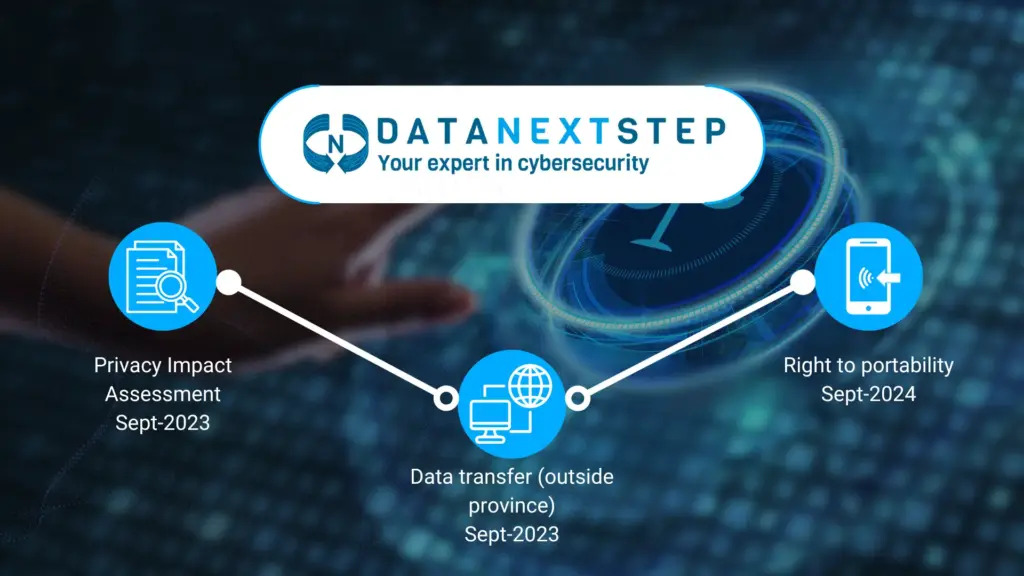
Companies must now prepare for these new legal obligations, which include enabling clients, partners, and other stakeholders to retrieve their personal data in a structured, commonly used, and secure format. Complying with this law is essential not only to respect your clients’ rights but also to protect your business from cyber risks and potential legal sanctions.
Why data portability is important
Data portability is a crucial aspect of privacy protection. It allows users to retrieve their personal information and easily transfer it to another service. This offers greater transparency and improves trust between companies and their clients. In sectors like telecommunications, financial services, or technology, this transparency becomes a key differentiator for businesses in Quebec.
Examples of companies already implementing data portability:
Google: Through its data retrieval service, Google allows users to retrieve and transfer their information between different services, such as Gmail or Google Photos, making it easier to manage personal data.
Facebook: Facebook also allows its users to download all their personal information, which enhances user trust while giving them more control over their own data.
Canadian Banks: Some banks in Canada allow their clients to transfer their banking data to other financial institutions, enhancing flexibility and ease of use for customers.
How to achieve this:
Step 1: Conduct a data inventory
One of the first steps to comply with Law 25 is to perform a complete inventory of the personal information you collect and store. This includes data from your clients, partners, and employees. This step allows you to assess the quantity and sensitivity of the information you need to protect and better understand the measures required to ensure data security.
Step 2: Evaluate your technological systems
Do your current systems allow for the transfer of personal information in an easy-to-use format? If not, it’s time to upgrade your tools to enable data portability in compliance with Law 25. This could include simple solutions like data files that your clients can use with other services.
Step 3: Establish processes for data portability requests
Create clear and accessible processes to enable your clients and partners to request the retrieval of their personal information. This could include a secure online form or a simple procedure to follow. Ensure that each request is handled quickly and efficiently to guarantee personal information protection that meets expectations.
Step 4: Secure data transmission
Ensure that personal information is transmitted securely to avoid any risk of interception or unauthorized use. This prevents risks related to data breaches or cyberattacks. This could include using secure transfer methods to ensure that sensitive information is not compromised.
Bonus: Data portability as a resilience and business continuity asset
By making your data more easily transferable, you allow your company to become more resilient in the face of changes. For example, if you need to switch suppliers or technological infrastructure, data portability allows for a smooth transfer of information to a new system. This helps you avoid excessive dependence on a single supplier, a situation known as vendor lock-in, which can make migration to other solutions costly and difficult.
Moreover, portability facilitates business continuity in times of crisis, allowing you to maintain your operations without interruption (example: Crowdstrike). By making your data more flexible, you improve your company’s ability to adapt to different environments without compromising security or losing efficiency.
Conclusion: Get ready now
September 22, 2024, is fast approaching. Preparing for this deadline and complying with the law on the protection of personal information is not just a legal obligation; it is also an effective way to strengthen your company’s security and protect your business relationships. By adapting now, you ensure the continuity of your operations while protecting your sensitive data.
Need Help?
Contact us for a free, personalized consultation. Our experts will guide you through every step to ensure your company’s compliance before the September 22, 2024, deadline: https://dev.dns.mtlti.com/fr/priserdv
Reference:
https://www.espaceobnl.ca/fr/contenus/l-essentiel-de-la-loi-25-comprendre-et-agir-en-obnl
https://www.espaceobnl.ca/fr/contenus/l-essentiel-de-la-loi-25-comprendre-et-agir-en-obnl
https://cai.gouv.qc.ca/uploads/pdfs/CAI_FIC_Pieces_ID_Entreprises.pdf?gt=l%E2%80%99entreprise
]]>Best Practices for IT Security Audits in Canadian Businesses
Implementing effective IT security audit practices is crucial for Canadian businesses to protect sensitive data, comply with regulatory requirements, and mitigate risks. This involves regular assessments, updated protocols, employee training, and incident response planning.
What is an IT Security Audit?
An IT security audit is a crucial step for any company looking to protect its sensitive data and ensure a robust digital infrastructure. This systematic process allows for the assessment of potential vulnerabilities, detection of security breaches, and identification of gaps in existing security policies. A comprehensive audit not only examines computer systems and networks, but also the procedures and operational practices that influence overall security.
What is the Purpose of an IT Security Audit?
Furthermore, the IT security audit helps assess compliance with current standards and regulations, such as the General Data Protection Regulation (GDPR) or the ISO/IEC 27001 standard or Quebec Law 25, thus ensuring that the company does not face legal risks. This thorough evaluation also helps to identify risks before they become serious threats, allowing the company to implement proactive corrective measures. Useful resources for small businesses seeking compliance with cybersecurity standards can be found here: Cybersecurity Resources for Small and Medium Enterprises
The Importance of Conducting an IT Security Audit for Canadian Businesses
The significance of this audit lies in its ability to provide a clear overview of the current state of the company’s IT security. It allows for the prioritization of corrective actions, optimization of cybersecurity resources, and continuous improvement of defence strategies. Ultimately, a well-conducted security audit not only helps protect sensitive information but also preserves the reputation and trust of clients, two essential elements for the longevity of any organization in an increasingly complex and threatening digital environment.
In-Depth Analysis of Your IT Systems
Our IT security audit approach starts with a thorough analysis of all critical aspects of your network and systems. Also, read our article about the Steps of an audit.
We begin with a detailed assessment of existing security protocols, scrutinizing firewall configurations, data encryption settings, and intrusion detection mechanisms. Each element is examined to ensure compliance with the best security practices and to identify potential vulnerabilities that could be exploited by attackers.
https://www.ovhcloud.com/en-ca/learn/what-is-encryption
We also conduct a detailed IT security audit of access management policies, analyzing user access rights, multifactor authentication processes, and access controls to sensitive resources. This review allows us to identify potential configuration errors or gaps in access controls, ensuring that only authorized individuals have access to critical information.
This comprehensive evaluation enables us to detect potential weaknesses in your infrastructure and develop precise, tailored recommendations to strengthen your cybersecurity. Our suggestions include corrective measures such as improving firewall configurations, enhancing security policies, and implementing advanced technological solutions to effectively protect your data and systems from emerging threats.
IT Risk Assessment
The IT risk assessment is at the core of our audit method. We identify and classify potential threats, considering their likelihood of occurrence and their impact on your business. This proactive approach allows us to prioritize necessary security measures and provide you with a clear action plan to minimize risks.
Additionally, we develop incident scenarios to test the resilience of your systems and prepare suitable response strategies. This approach ensures that your company is not only protected against current threats but also prepared to address future vulnerabilities effectively.
Contact us today to learn more about our IT security audit service and discover how we can strengthen your company’s defence against cyber threats.
At Data Next Step, we understand the critical importance of IT security in a constantly evolving digital environment. Our team of experts is dedicated to providing you with precise and pragmatic recommendations to protect your digital assets and ensure the continuity of your operation.
]]>